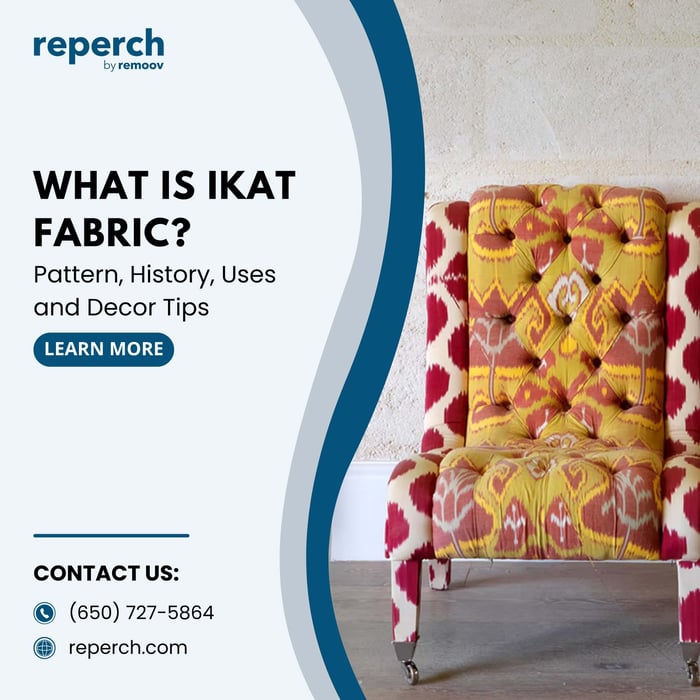
Ikat is a patterned textile made with a resist-dye technique on the yarns before the fabric is woven. Instead of printing a design onto finished cloth, makers bind and dye bundles of thread first, then weave those dyed threads into fabric. That’s why ikat has a signature look that feels more dimensional and “built in” than a surface print.
If you have seen a pattern that looks slightly soft or feathered at the edges, that is often a real ikat clue. The design has to line up during weaving, and that tiny bit of movement in the yarns creates a handmade, lived-in effect that many people love.
Why it’s called “ikat”
The word “ikat” comes from an Indonesian root commonly described as meaning “to tie” or “to bind,” which fits the process. Portions of the yarn are tied tightly so they resist dye, then those bindings are removed and the yarn is dyed again as needed to build the pattern.
How ikat patterns are made
The basic concept is simple, but the execution takes skill and patience.
First, the weaver plans the design and maps where colors should land. Then the yarn is bundled and tied in specific sections. Those tied areas resist dye, so when the yarn is dipped, only the exposed sections take color. For multi-color patterns, the yarn is tied and dyed in stages. Finally, the dyed yarns are placed on a loom and woven into fabric. The pattern appears as the threads line up and interlock.
The key difference from tie-dye or batik is timing. With ikat, dyeing happens before weaving, not after.
The main types of ikat
You will often see ikat described in three categories based on which direction of yarn is dyed.
Warp ikat
Only the warp threads (the lengthwise threads on a loom) are dyed. The weft threads are usually left solid. This often creates patterns that feel directional and structured.
Weft ikat
Only the weft threads (the crosswise threads woven through) are dyed. This can produce a slightly different rhythm, often with a more fluid feel depending on the motif.
Double ikat
Both warp and weft threads are dyed, and the patterns must align during weaving. This is the most complex type and tends to be rarer, because it requires extreme precision.
A quick history of ikat
Ikat traditions exist across multiple regions, and that’s part of its appeal. You’ll see strong associations in Southeast Asia (including Indonesia), South Asia (notably India), and Central Asia (such as Uzbek silk ikats), with related resist-dye weaving traditions also appearing in other parts of the world.
For home decor, the takeaway is that “ikat” is not one look. Some ikats are bold and graphic, some are soft and earthy, and others feel almost painterly.
How to recognize ikat in real life
When you’re shopping, look for these signals:
Soft edges in the pattern: Real ikat often has slightly blurred lines from yarn alignment during weaving.
Pattern that feels woven in, not printed on: Many ikats show the design through the textile rather than looking like ink sitting on the surface.
Small irregularities: Handmade ikat may not repeat with perfect uniformity, and that’s part of what makes it feel special.
You will also see “ikat print” everywhere. Printed versions can still be beautiful and budget-friendly, but they won’t have the same depth or character as resist-dyed ikat.
Where ikat works best in home decor
Ikat is easiest to use when you treat it like a statement ingredient. You do not need a lot of it to make a room feel layered.
Pillows
Ikat pillows are the simplest entry point. They add pattern without taking over the room. If your sofa is neutral, two to three pillows in a tight palette can instantly make the space feel more intentional.
Upholstered chairs
Ikat looks especially strong on simple chair silhouettes, because the fabric becomes the focal point. This works in dining rooms, reading corners, or even a bedroom accent chair.
Curtains
Curtains are higher commitment, but they can be stunning. If you go this route, keep other patterns minimal and let ikat carry the visual interest.
Rugs
Ikat-inspired rugs can anchor a room. If you want the look without too much visual noise, choose a larger-scale pattern. Small busy motifs can feel chaotic in tight spaces.
Lampshades and small accents
A lampshade, bench cushion, or framed textile panel gives you the “ikat moment” without committing to a large piece.
Decor tips so ikat looks intentional, not random
Start with a color plan
Pick two main colors from the ikat and repeat them elsewhere in the room. That could be in art, a throw, a vase, or one other textile. Repetition is what makes pattern feel designed.
Balance with solids and texture
Ikat is already active, so pair it with calmer materials: linen, wool, leather, natural wood, matte ceramics. This keeps the room from feeling busy.
Mix patterns carefully
If you want to mix ikat with stripes or florals, use one simple rule:
keep the color family consistent, or
keep the pattern scale consistent, or
make ikat the hero pattern and keep everything else subtle.
Let at least one element stay simple
If your ikat is bold, choose simpler furniture shapes. If your furniture is ornate, choose a calmer ikat. That balance is what keeps the room feeling elevated.
How to buy ikat secondhand without regret
Secondhand is one of the best ways to buy ikat pieces that feel unique and well-made, but do a few quick checks:
Ask what it is made of: Cotton and silk are common. Fabric content affects how it drapes, wears, and cleans.
Check for sun fading: Ikat used near windows can fade unevenly, especially on pillows and chairs.
Inspect seams and stress points: On upholstered pieces, look at corners, piping, and seat edges where wear shows first.
Smell test for upholstered items: Odors can settle into foam and batting and are harder to remove than surface stains.
If a piece is structurally great but the textile is worn, it may still be worth it if you love the frame and the price makes sense. Just be realistic about cleaning or reupholstery costs.
Where Reperch Fits In
Ikat is one of the easiest patterns to shop secondhand because it instantly adds character, even in small doses. A pair of ikat pillows, an upholstered accent chair, or a vintage textile-style runner can give your room that “collected” look without buying an entire matching set.
Reperch makes this simpler because you can shop pre-owned pieces that already have texture and personality, then build the room slowly around them. Start with one ikat accent, repeat one or two colors elsewhere in the space, and you’ll get a finished, intentional look without overdoing pattern.
Final thoughts
Ikat fabric has lasted for centuries for a reason. It brings color, movement, and a handmade quality that makes a space feel collected instead of generic. You do not need to cover a whole room in it. One or two well-chosen ikat elements, used with a simple color plan and plenty of breathing room, can do more than a full set of matching decor ever will.