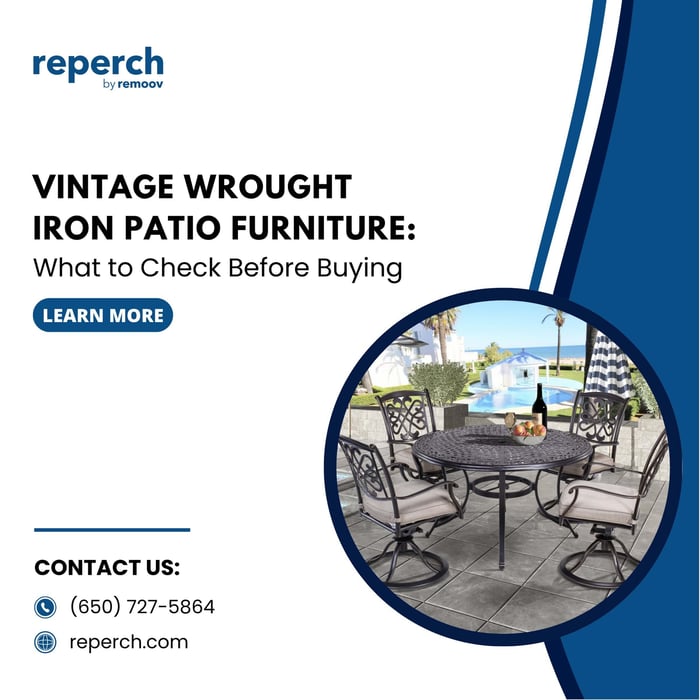
Vintage wrought iron patio furniture has a way of making an outdoor space feel settled, collected, and full of character. Even a single chair or table can change the mood of a porch, patio, or garden. The lines often feel more graceful than newer mass-market pieces, the frames tend to feel more substantial, and the overall look brings a kind of timeless charm that is hard to fake.
That is exactly why so many people are drawn to it secondhand.
A good vintage wrought iron set can outlast a lot of newer outdoor furniture, and it often looks better doing it. But buying it used takes a little more care than falling for a pretty silhouette or an interesting scroll detail. Patio furniture lives outside. It deals with rain, sun, humidity, dirt, temperature swings, and years of wear. A piece can still look beautiful at first glance and have deeper issues hiding underneath the finish.
If you are shopping for vintage wrought iron patio furniture, here is what to check before you buy so you can bring home pieces that are actually worth the space, effort, and money.
Why Vintage Wrought Iron Patio Furniture Is Still So Popular
There are plenty of reasons people keep coming back to wrought iron for outdoor furniture.
The first is durability. Good metal patio furniture can last for decades. It has a weight and strength that lighter materials often do not. A sturdy wrought iron chair does not usually shift around in the wind, and a well-made table often feels far more grounded than newer lightweight alternatives.
The second is style. Vintage wrought iron has a distinct look that can work in many kinds of outdoor spaces. It can feel traditional, romantic, European, garden-inspired, or even surprisingly modern depending on the lines and the way you style it. Some pieces are ornate and decorative. Others are simple and clean. That range makes it easier to work vintage iron into different homes.
The third is value. When you buy secondhand, you can sometimes find older patio furniture with much better construction than what the same budget would get you new. That does not mean every listing is a great buy, but it does mean the potential is there. Learning how to spot quality in secondhand furniture before you buy can make it easier to separate a solid vintage find from something that only looks good in photos.
Start by Making Sure It Is the Right Kind of Piece for Your Space
Before you check the condition, ask whether the furniture actually fits your outdoor setup.
A vintage wrought iron dining set may be beautiful, but it will not help much if your patio only has room for a small bistro table. A pair of oversized lounge chairs may look incredible in photos but feel crowded and awkward on a narrow porch. Wrought iron furniture often has more visual presence and more physical weight than people expect, so scale matters right away.
Measure the area where the furniture will go. Think about how much space you need for walking, pulling chairs out, and moving around comfortably. If you are buying a table with chairs, do not just measure the tabletop. Think about the full footprint once people are actually sitting there.
This matters even more with secondhand outdoor furniture because returns are often not simple, and transporting a heavy metal set twice is not something most people want to do.
Check Carefully for Rust, but Know What Kind Matters
When people shop for old iron furniture, rust is usually the first concern. That makes sense, but not all rust means the same thing.
Light surface rust is common and often manageable. You may see it around the legs, under the seat, near decorative curves, or where the finish has worn thin over time. Surface rust usually means the top coating has broken down a bit and the metal is reacting to moisture. In many cases, that can be cleaned up and refinished.
What you want to watch more closely is deeper corrosion.
If the rust has eaten into the metal, caused flaking, created pitting, or weakened the frame, that is a bigger issue. A chair leg that looks rough but still feels solid is one thing. A leg that feels thin, brittle, or unstable is another. The same goes for areas where water may have collected repeatedly over time, such as joints, foot caps, undersides, or decorative scrollwork.
Look closely at the bottom of the legs, the areas where parts meet, and any place where paint or coating is bubbling. Bubbling can be a sign that rust is active underneath the surface.
A little age is fine. Structural damage is not.
Look Closely at the Welds and Joints
One of the easiest ways to judge whether vintage wrought iron patio furniture is still a strong buy is by checking the welds and connection points.
Outdoor furniture gets moved, dragged, leaned on, and left in changing weather for years. The stress tends to show up where parts join together. That is why the welds deserve your attention.
Look at the places where legs meet the seat frame, where chair backs connect, where arms join the body of the chair, and where table bases support the top. You want those areas to feel secure and intact. If you see cracks around the welds, separation, or signs of weak patchwork repairs, take that seriously.
Old repairs are not always a deal breaker, but they need to be judged honestly. A professional repair that restored strength can be perfectly fine. A rough fix that only made the piece look passable for photos usually is not.
Press gently on the furniture from different angles. Sit in the chairs if possible. A little sound from old metal is not unusual, but wobbling, shifting, or flexing in the frame is a warning sign.
Pay Attention to Weight and Stability
One of the nice things about genuine older wrought iron furniture is that it usually feels substantial. That weight is part of the appeal. It helps the furniture stay put outside, and it often signals that the construction is solid.
Still, heavy does not automatically mean stable.
A chair can be heavy and still rock because the legs are slightly bent. A table can feel substantial and still wobble because one connection point has loosened over time. You need both: a reassuring weight and a stable structure.
Set each piece on a flat surface if you can. See whether all points meet the ground evenly. If a chair rocks too much or a table shifts when pressed, ask yourself whether it is a small adjustment issue or a sign of deeper distortion in the frame.
This is especially important with patio tables. If the base is not level, the whole set becomes frustrating to use. Drinks tip. Plates slide. The table never feels settled. Outdoor furniture should make a space easier to enjoy, not more annoying.
Examine the Finish and Protective Coating
Vintage wrought iron patio furniture almost always depends on its finish to help protect the metal underneath. That is why the condition of the coating matters so much.
Some older sets have been painted several times. Others still have remnants of an original finish. Some may have been powder coated later. The question is not whether the finish is perfect. The question is whether it is still protecting the furniture well enough or whether you are signing up for a refinishing project.
Look for peeling, chipping, bubbling, or large bare patches. A few worn spots are normal. A finish that is failing across the entire piece means more work ahead.
Also pay attention to whether the furniture was refinished well in the past. A fresh coat of paint can make a listing look promising, but a sloppy paint job often hides rather than solves problems. Paint that is thick, uneven, drippy, or covering active rust should make you cautious.
A well-refinished set can be a great buy. A poorly disguised one often turns into more effort than expected.
Do Not Forget About Comfort
Vintage patio furniture needs to look good, but it also needs to feel worth using.
This is one place where buyers sometimes get distracted by style and forget how the furniture will actually function. A delicate wrought iron chair may look beautiful in a garden, but if the seat is too small, the back angle is awkward, or the arms hit in the wrong place, you may never want to sit there for more than a few minutes.
Try the seating if possible. Pay attention to the seat width, the back support, and the height. Some older patio chairs are quite upright, which may be fine for dining but less comfortable for lounging. Others feel much better with cushions, so think about whether you are willing to add them and whether the proportions still work once cushions are in place.
Also check whether cushion ties, seat supports, or mesh inserts are intact if the design includes them. A metal frame may be strong, but if the seat structure needs rebuilding, that changes the value of the piece.
Comfort matters more than many people expect in outdoor furniture because these are the pieces meant to help you linger.
Ask Where and How the Furniture Was Stored
Storage history can tell you a lot about the condition.
A set that lived under a covered porch or in a dry garage during the off-season may have aged much more gently than one that sat uncovered in a wet climate year-round. Sun, moisture, salty air, snow, and freeze-thaw cycles all affect metal differently.
Ask simple questions. Was it kept outside all year? Was it covered? Was it repainted? Has it been restored before? Has anything been welded or replaced?
You may not always get a detailed history, but even a little context helps. It can explain why one vintage chair has a lovely aged finish and another from the same era has heavy corrosion around every joint.
If the seller does not know the history, let the condition tell the story as much as possible.
Check for Missing or Replaced Parts
Vintage wrought iron furniture sets are often sold as mixed groups over time, and that can be perfectly fine. But you still want to notice whether the pieces really belong together and whether anything important is missing.
Look at chair heights, seat styles, arm shapes, and leg details. A set of four chairs that are slightly different may still work beautifully if the scale is close and the style feels intentional. But if one chair sits lower, another has a different back pattern, and a third feels less sturdy, the set may not be as cohesive as it first appears.
On tables, check whether the top, base, glides, and any support rings all seem original or at least properly fitted. Missing feet or worn bottom caps can affect stability and can also expose the metal to more moisture over time.
None of this means you must avoid furniture with variation. It just means you should know what you are buying and price it accordingly.
Decide Honestly Whether the Restoration Is Worth It
A lot of vintage wrought iron patio furniture can be restored. The better question is whether it should be, and whether you actually want that project.
Some buyers love the idea of refinishing an old patio set. If the structure is strong and the only real issue is a tired finish, the work may absolutely be worth it. Older iron furniture often has enough character and quality to justify restoration.
But the math changes when the piece needs rust removal, sanding, repainting, welding, replacement glides, new cushions, and transport before it even becomes usable. At that point, the low asking price may not mean much.
Try to think beyond the initial thrill of finding a vintage piece. Ask yourself what the furniture will cost in time, money, and effort before it actually earns its place in your outdoor space. This is why learning tips for buying quality second-hand furniture can help you think more clearly about condition, value, and whether the piece is truly worth bringing home.
Sometimes a weathered but solid set is a wonderful opportunity. Sometimes it is just a heavy future project disguised as a bargain.
Why Vintage Wrought Iron Patio Furniture Is Worth Buying Secondhand
Outdoor furniture can be surprisingly hard to buy well secondhand. Photos often hide rust, scale is easy to misjudge, and a lot of older patio pieces either need too much work or are simply not worth the trouble.
That is part of why a more thoughtful secondhand source matters.
A good vintage wrought iron piece should bring more than old-world charm. It should give you real function, lasting structure, and the kind of look that makes an outdoor space feel established instead of temporary. That is exactly the kind of value secondhand furniture should offer.
If you are browsing online before seeing a piece in person, knowing how to shop for vintage furniture online with confidence can help you review photos, measurements, descriptions, and condition details more carefully.
Reperch fits that approach well because it makes it easier to find furniture with personality and purpose, not just random pieces that happen to be available. When you are buying something as exposed and hardworking as patio furniture, that extra thoughtfulness matters.
Final Thoughts
Vintage wrought iron patio furniture can be one of the best outdoor furniture buys you make if you know what to look for. The right pieces bring durability, character, and a sense of permanence that is hard to get from many newer options.
The key is checking more than the look.
Pay attention to rust, welds, stability, finish, comfort, size, and storage history. Be realistic about repairs. A little wear is part of the appeal, but deeper structural problems are not something to overlook just because the style is charming.
When you buy carefully, vintage wrought iron can give your outdoor space something special. It can make a patio feel more finished, a porch feel more inviting, and a garden setup feel like it has really found its furniture rather than borrowed it for a season.